

Quantum Computers & Humanoid Robots
A preview into the future is available now - and it's not just AI.

It’s 2025. We’re in the AI age. Each week brings some incremental releases in LLMs that are breaking new ground.
But we can’t always be doing that.
OpenAI’s GPT 4.5, Claude’s 3.7 Sonnet... same old grape, same old wine.
This week, we’re talking about Quantum Computing (owing to Microsoft’s new Majorana chip), Androids (humanoid robots), and the future of humanity.
First the basics:
What is a quantum computer? And how is it different from the computer/mobile that I’m reading this on?
Regular computers use bits (0s and 1s) to process information. Think of it like a light switch—either ON (1) or OFF (0).
Every input and instruction in regular computers is built upon binary code—a combination of bits.
For example, when you type “a” the computer understands it as:01100001(in binary).
Likewise, when you type "apple", your computer understands it as:01100001 01110000 01110000 01101100 01100101.
All operations in classical computing follow boolean logic and use logic gates (like AND, OR, and NOT) to manipulate bits in a definite, exact manner.
So, classical computing is deterministic => meaning you will always obtain the same result from a given input.
Quantum computers, however, use qubits.
Unlike bits, qubits can exist in multiple states at the same time. Along with being in either 0 or 1 states, qubits can exist in a superposition, i.e. in both 0 and 1 states simultaneously until measured. Remember Schrödinger’s Cat, where the cat is both alive and dead until you check?

Qubits also possess the property of entanglement. Entanglement, as the name suggests, is when two qubits become linked in such a way that the state of one instantly affects the other, no matter how far apart they are. This allows quantum computers to perform calculations in parallel, making them exponentially more powerful for specific tasks.
So, quantum computing is probabilistic, and it follows quantum logic.
And, because of superposition and entanglement, quantum computers can process certain complex problems exponentially faster than even the most powerful supercomputers.
To illustrate the differences between the two, imagine trying to find the best route in a maze.
A classical computer checks each path one by one (deterministic & sequential processing—even with parallel processing like in a GPU).
A quantum computer explores all paths at once (due to superposition) and highlights the most probable correct route (probabilistic but structured).
If quantum computing is probabilistic, does that mean that 2+2 can be 5 sometimes?
Probablity in quantum computing doesn't make basic math (like 2+2) unreliable. If a quantum computer were asked to compute, 2+2 it would still return, 4 just like a classical computer.
Quantum computers leverage probability and superposition to excel in problems involving large amounts of unstructured data, pattern recognition, and optimization like:
Optimization problems: finding the best solution among many possibilities, such as supply chain logistics or financial modeling.
Search problems: like Grover’s algorithm speeding up database searches.
Quantum simulations: where probabilities are fundamental, like modeling molecules, drug efficacy, weather predictions, and other naturally probabilistic systems.
Faster Machine Learning (Quantum Machine Learning - QML): Currently, AI models, especially the LLMs, take months to train on classical computers. Using QML, they could be trained in minutes/hours.
Why do we need quantum computing if it’s so probabilistic and not exact?
Nature operates under quantum mechanics at a fundamental level.
While we understand macroscopic processes—like how a fruit grows or how a human is born—we cannot always predict why two fruits from the same tree differ in shape, size, taste, or color. Similarly, identical twins share the same DNA but can have subtle physiological differences due to microscopic quantum-level processes.
At the atomic and molecular level, this inherent quantum randomness influences biological development, chemical reactions, and even neurological functions. Quantum computing doesn’t eliminate this randomness, but it helps analyze and simulate complex quantum behaviors that classical computers struggle with.
For example, imagine cancer treatments or vaccines tailored precisely to your unique physiology rather than relying on generalized drugs or treatments.
Picture a customized pill that delivers the exact vitamins, minerals, and proteins that your body needs without the trial-and-error of multiple supplements. Bryan Johnson might wanna invest in quantum computing instead, don’t you think?
This level of personalized medicine, along with breakthroughs in drug discovery, materials science, and AI, is what quantum computing makes possible.
All this ties into making machines faster.
And the application of these faster machines results in only 1 future—andorids or humaoid robots.

Anyway, why am I even wasting your time with this long of a background? Because we had breakthroughs in both these avenues this past few weeks
1. Microsoft’s New Quantum Chip
Microsoft came out with an announcement regarding their new quantum chip, the Majorana 1.
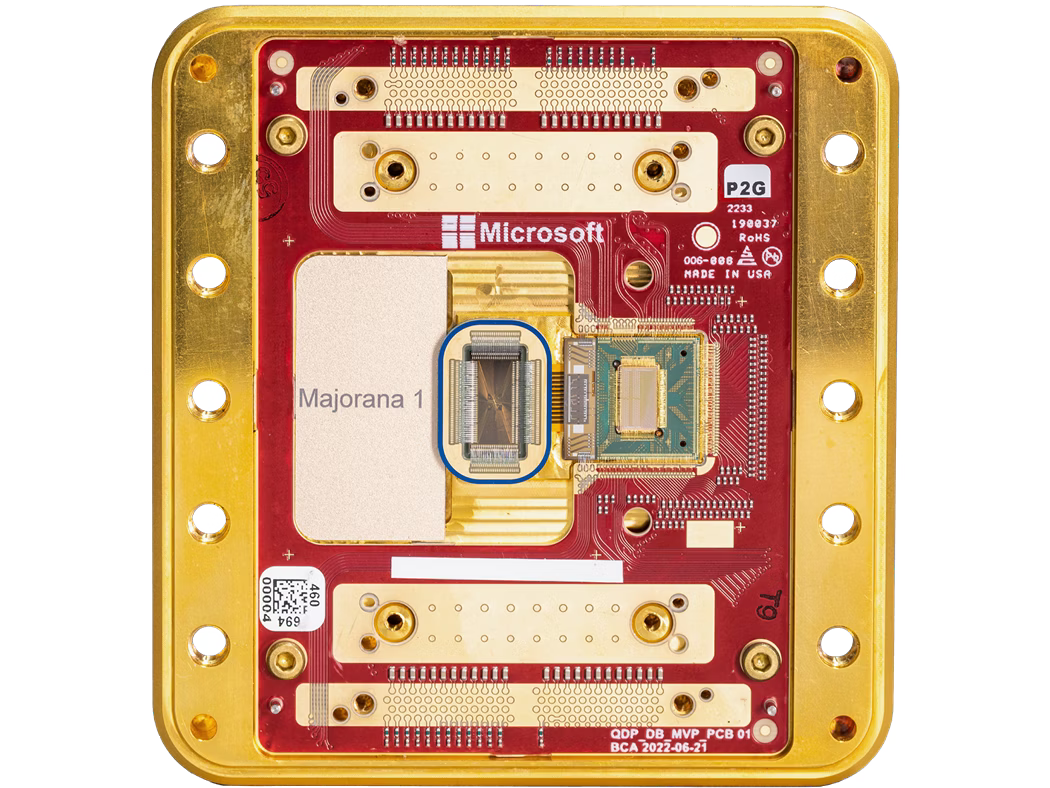
Touted as a breakthrough in the realm of quantum computing, the announcement broke the AI/tech internet.
Background: Traditional quantum bits (qubits) are highly sensitive to their surroundings and prone to errors. However, the Majorana chip uses topological qubit, which is much more resistant to interference and can maintain quantum states for longer.
Before Microsoft, IBM and Google (and many others) have already created their own Quantum chips which use superconducting qubits (much easier to build but are highly susiptible to noise) — but Microsoft stands alone in using the topological qubits for the first time.
Microsoft’s new quantum chip currently supports 8 qubits (for reference, Google’s Willow Quantum chip supports 105 qubits) but has claimed that they can increase it to a million qubits soon.
For now, the boroader scientific community is currently sceptic of these claims. Microsoft’s research paper even got a fierce rebuttal on their claims.
But this is still a great leap in the right direction.
2. The Rise of Bipedal Humanoids
Humanoids have captured the imagination of humanity for a very long time now.
We’ve had them in the form of Frankestin’s monster to RichyRich’s robot.

We’ve had humanoids in the past. But none have come closer to the renditions that have been propogated through sci-fi.
The future of humanoid robots needs innovations in all fields—quantum computing, AI advancements, and bio-inspired engineering—for bringing us closer to machines that move, think, and interact like humans.
We’ve had breakthroughs in AI this year.
We’ve had breakthroughs in quantum computing.
And now, we’ve had a new breakthrough in bio-inspired engineering by Clone Robotics.
Clone Robotics recently shared a sneak peak of their musculoskeletal andorid.
They call this Protoclone and it’s a faceless, anatomically accurate synthetic human with over 200 degrees of freedom, over 1,000 Myofibers, and 500 sensors.
Clone Robotics have already previously created a human-like hand and mastered the implementation of a legendary human thumb—in order to replicate how the human body works.

It is often said that bio-mimicry is a crucial step in the adoption of robots in human society. The subject of Human Robot Interaction dedicated to this end. And getting these details is crucial in that step.
But this is just one company. There are many companies that are working on humanoid andorids—at different stages, with different usecases.
A few other companies working on Humanoids include:
Figure AI: Figure AI is building a bipdeal humaoid robots to assist in the blue-collar workforce. The company is aiming to fulfill the manpower shortages in the retail, warehouse, and transportation sectors.
Neo Gamma: NEO Gamma is a home humanoids designed and engineered by 1X Technologies. The company markets this to be able to help you clean and have a firendly robot at home.

And, the last pick,
Tesla Optimus: The Elon Musk-led world leader in self-driving cars ventured into robotics with Optimus to create a "general-purpose humanoid robot capable of performing unsafe, repetitive, or boring tasks.”.
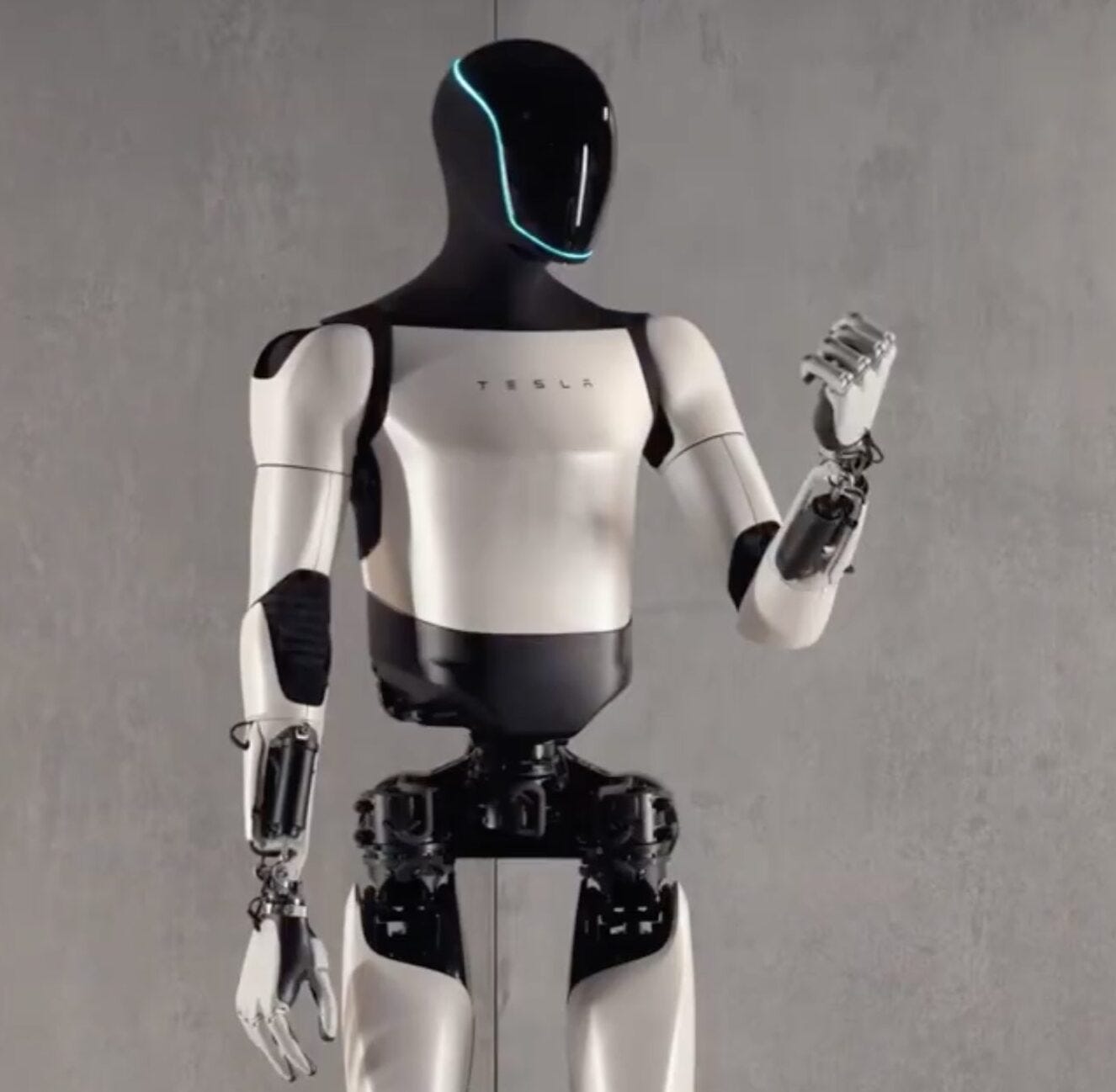
Although Tesla has not commented on what all Optimus would be capable of—even after multiple demos — we’re still hopeful that they’d clearly be a force to be reckoned with in this arena. Why you ask? With Musk’s track record of ambitious innovation, Tesla’s deep pockets, and its extensive experience across industries, the company is best/well-positioned to be a dominant force in the robotics space.
We established from our last article that the future of humanity is intergalactic, superintelligent, and immortal.
In a world where birth rates are declining and the world is becoming more prosperous, there are jobs that humans might not/should not want to do.
In such a world, a personal robot is just what every other human would want.
In other news,
Claude 3.7 Sonnet is here
This comes with 8x more output compared to their older 3.5 Sonnet model. It crushed the benchmarks—are we even surprised?
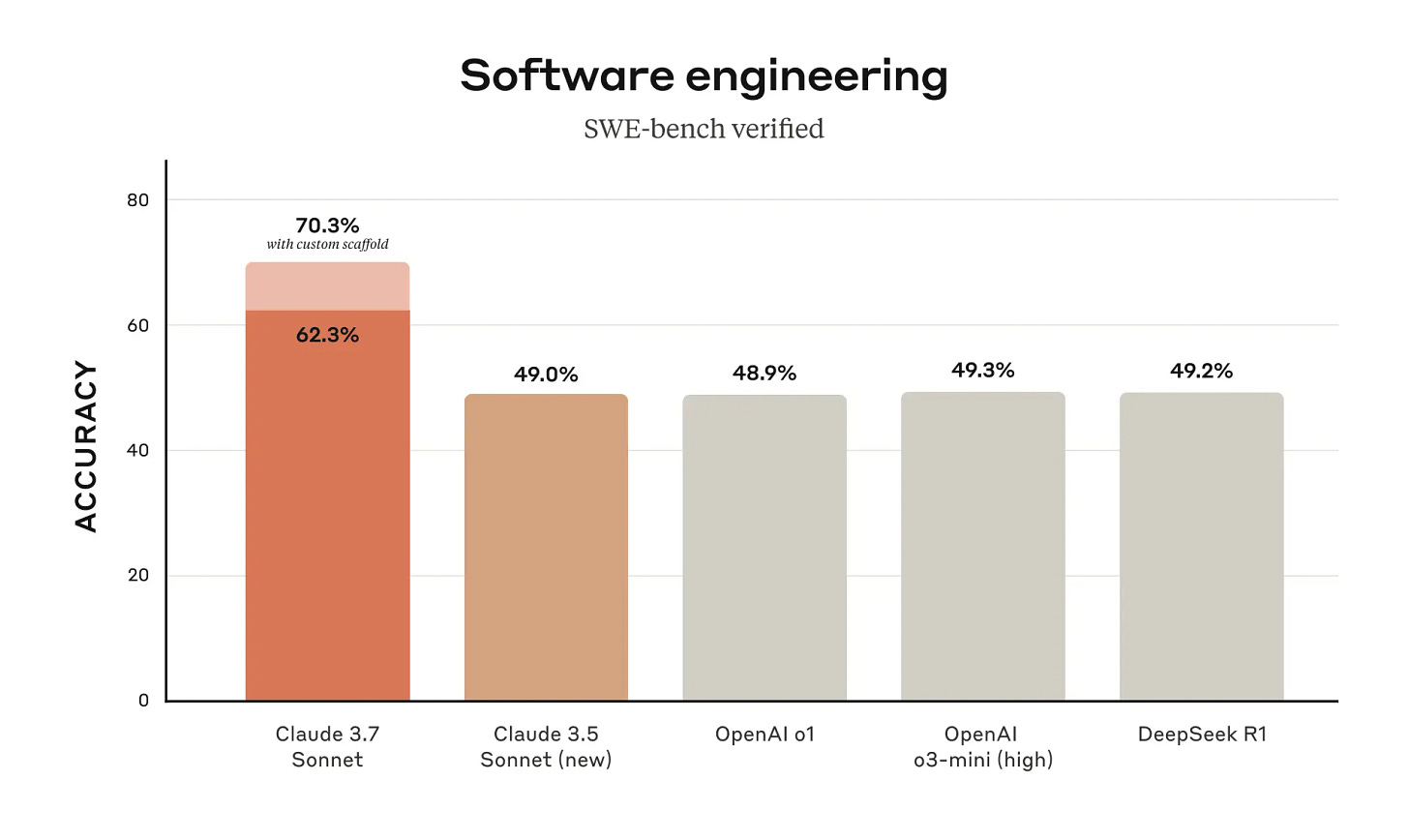
To compete with Cursor, they’ve also announced Claude Code, an agentics coding tool in research preview.
Thank you for reading it thus far! These two past weeks have been monumental in humanity, pushing the limits to the future.
Next week, we'll write about LLMs hitting the wall with the innovations and ROI possible. Thanks, DeepSeek!
Until next week!

[Sources for this article]